
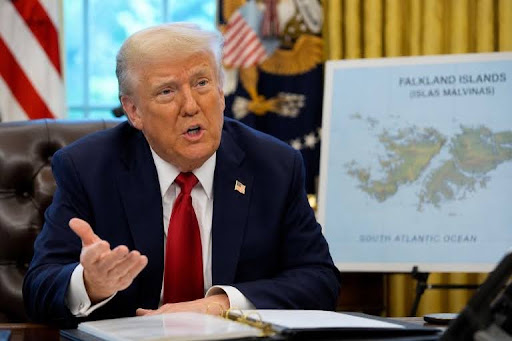
In a move that could potentially impact the longstanding US-UK alliance, Donald Trump has suggested a possible reevaluation of the US’s support for Britain’s claim over the Falkland Islands. Responding to inquiries about Washington’s position on the South Atlantic territory, Trump noted that he routinely reassesses all policies, framing this issue as one of many under consideration. While the US officially maintains a neutral stance regarding the sovereignty dispute between Britain and Argentina, it has tacitly acknowledged British governance of the islands, which have been under British control almost continuously since 1833. The islands were the center of a brief but intense conflict in 1982 when Argentina attempted to seize control.
Trump’s remarks are interpreted as a strategic indication that his administration might leverage the Falklands issue to pressure the new British government, led by Prime Minister Andy Burnham, to bolster its defense expenditure and contributions to NATO. In response, a spokesperson for Burnham reiterated Britain’s firm stance, emphasizing that the islanders identify as British, wish to remain a UK overseas territory, and that London is dedicated to fulfilling its defense obligations internationally. This development follows reports citing an undisclosed US official who hinted that Washington might reconsider its position if the UK does not meet its defense spending commitments, amid speculation that the UK’s financial plans could potentially reduce the target of raising defense spending to 3% of GDP by 2030.
Consistently pushing allies to enhance their defense budgets has been a hallmark of Trump’s foreign policy approach during both his administrations. NATO allies had previously agreed to boost defense and security expenditures to 5% of GDP by 2035. Discussions about a possible shift in the US stance on the Falklands have been ongoing for months, especially after a leaked Pentagon document suggested reevaluating Britain’s claim due to disagreements over the Iran conflict.
A shift in the US policy on the Falklands would be symbolically significant. During the 1982 Falklands War, the US provided crucial diplomatic support to Britain, aiding its military efforts to retake the islands following Argentina’s invasion—a conflict that saw significant casualties on both sides and fortified a strong political alliance between the nations’ leaders at that time. In recent years, Trump’s administration has fostered a closer relationship with Argentina’s president, who has advocated for Argentina’s claim to the islands. Trump has previously granted substantial financial aid to Argentina contingent on certain political outcomes and relaxed trade barriers on Argentinian beef imports.
In 2013, a referendum revealed overwhelming support among Falkland Islanders to remain under British sovereignty. Tensions surrounding the issue were reignited after an incident involving Argentinian athletes making a politically charged gesture after a sports event, resulting in a penalty from the sport’s governing body. As international relations continue to evolve, any adjustment in the US’s position on the Falklands could have far-reaching implications for diplomatic ties and regional stability.