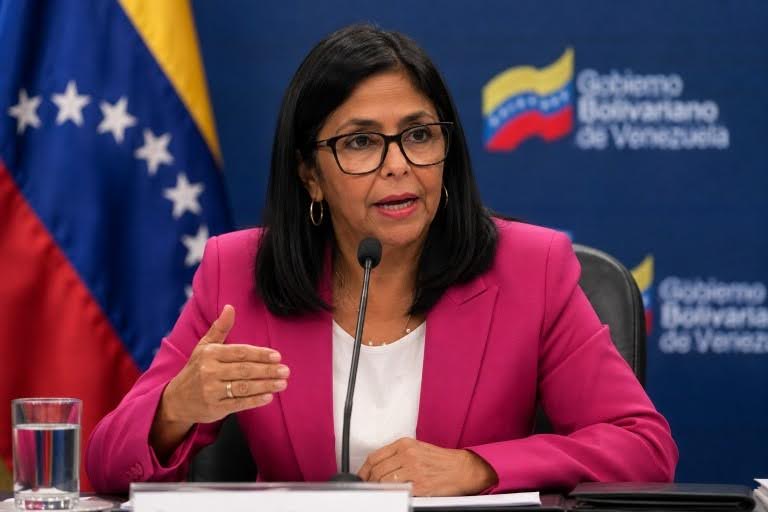
Delcy Rodríguez, Venezuela’s interim president, has come under scrutiny for a contentious energy agreement she recently defended, emphasizing that her country maintains control and sovereignty over its oil reserves. Rodríguez, who assumed leadership after Maduro’s removal through a U.S.-backed operation earlier this year, addressed the nation to challenge accusations of relinquishing national resources to the United States. She highlighted the extensive potential benefits of the agreement, projecting it could generate more than $209 billion in revenue, positioning Venezuela as a significant energy producer. According to Rodríguez, the vast underground oil reserves are of little value without the necessary investment, technology, and infrastructure to turn them into tangible economic benefits for the Venezuelan populace.
Negotiated in secrecy over several months, the deal reportedly grants the United States control over a significant portion of Venezuela’s crude reserves, which are the largest proven reserves globally, surpassing those of Saudi Arabia and Iran. Rodríguez stated that the agreement encompasses 17 strategic oilfields, aiming for a production target exceeding 1.5 million barrels per day. Despite these ambitious goals, the announcement has sparked a considerable backlash from both opposition leaders and members within Rodríguez’s political faction. Detractors have labeled the arrangement a resource grab, with a former state oil executive condemning it as a betrayal of national sovereignty, noting that no similar transfer of reserves has occurred in Venezuela’s history.
Public discontent has manifested in protests, with demonstrators marching in Caracas to decry what they perceive as foreign infringement on national assets. Additionally, social media users have ridiculed the agreement, suggesting a rebranding of the state oil company. This development represents a stark reversal for Rodríguez and her political allies, who have historically opposed foreign control over Venezuela’s natural resources. Rodríguez herself has previously made public declarations warning against such deals, further highlighting the shift in stance.
Opposition leaders have raised concerns that the agreement might hinder efforts to reestablish democratic elections in the country. Questions about when future voting might occur remain unanswered, prompting critics to argue that genuine economic progress hinges on transparent governance and free elections. Without these elements, they warn, the agreement risks being built on an unstable foundation.