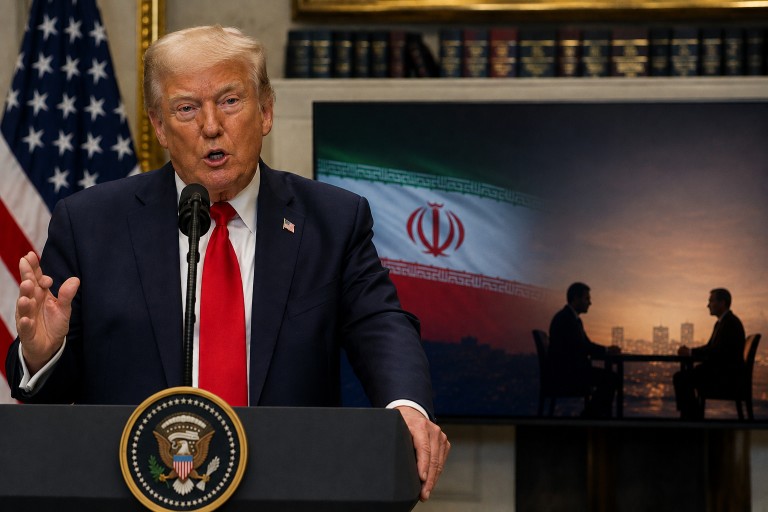
During a recent discussion aboard Air Force One, US President Donald Trump revealed that the United States had been on the brink of launching what he described as the “biggest attack since World War II” against Iran. However, the decision was reversed after several Gulf countries and Iran itself requested the postponement to allow for diplomatic efforts. Trump explained that Saudi Arabia, the United Arab Emirates, Qatar, and Iran all advocated for halting military actions, convinced that a diplomatic agreement was possible.
Trump highlighted that the primary focus of the potential deal would be on reopening the Strait of Hormuz and advancing efforts towards Iran’s denuclearization. The president emphasized his preference for diplomacy over military intervention, indicating that the US would hold off on any immediate military strikes while negotiations were ongoing. Trump’s stance underscores a broader strategy to resolve the issues through diplomatic channels, reflecting a willingness to explore peaceful solutions.
In a social media post on Truth Social, Trump asserted that any forthcoming agreement must include the immediate reopening of the strategic Strait of Hormuz, a vital shipping route, and a cessation of Iran’s nuclear threats. He made it clear that while the planned military operation has been shelved for the moment, the decision could change depending on the outcome of the negotiations.
The president’s remarks signal a cautious approach, balancing the need for security with the potential for diplomatic resolution. While the situation remains fluid, Trump’s decision to prioritize negotiations underscores a strategic pivot towards seeking a peaceful resolution, provided that the discussions yield the desired results concerning regional stability and nuclear non-proliferation.