
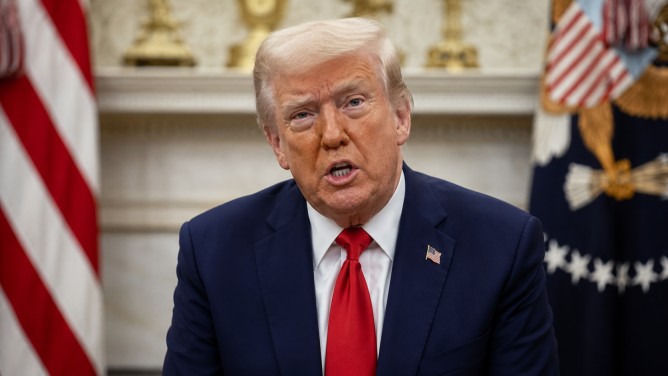
President Donald Trump clarified that the tariffs his administration plans to impose on Canadian goods are unrelated to the smoke from wildfires drifting into parts of the United States. During a meeting with Lebanon’s president, Trump emphasized that the tariffs are a response to trade disagreements with Canada, not environmental issues. He criticized Canadian leadership for allegedly mistreating American farmers and reiterated his administration’s disapproval of Ottawa’s trade practices.
Previously, Trump’s remarks had linked Canada’s failure to manage wildfires to the United States’ trade decisions, leading to speculation about whether these blazes influenced the tariff plans. However, he has now made it clear that the tariffs are rooted in ongoing trade disputes, not wildfire management. The White House recently announced a significant 50 percent tariff on a majority of Canadian imports, arguing that Canada employs discriminatory measures against U.S. products, particularly in the automotive, dairy, and alcoholic beverage sectors.
In response, Canadian officials have dismissed these accusations and are advocating for renewed negotiations to resolve the trade issues. They argue that the proposed tariffs, which are set to be implemented within 30 days, could be averted if both nations reach a mutual agreement. Despite the tensions, Canadian authorities are pushing for dialogue to ease the economic strain and stabilize trade relations.
The unfolding situation has sparked concerns over economic uncertainty and the potential impact on future trade relations between the United States and Canada. As the two neighboring countries navigate these challenges, the focus remains on finding a resolution that addresses the grievances on both sides while preserving the longstanding trade partnership.